Patterns / 1. Context: Money Smells
Pattern 1.1
Funded by One, Serving Another
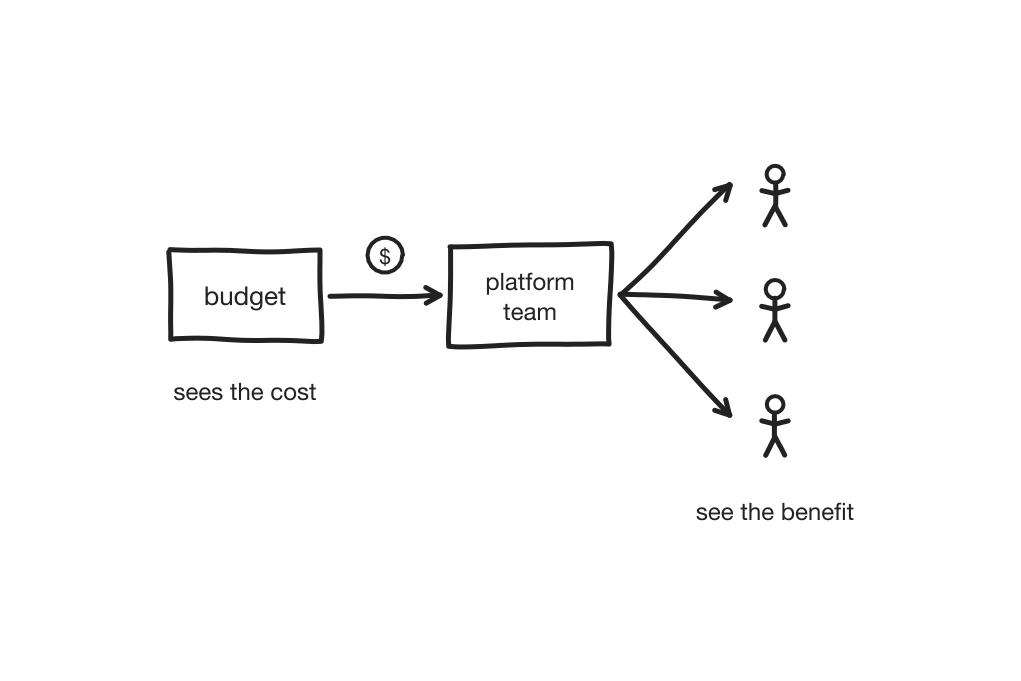
A team is paid for from one budget but delivers its value to teams under other budgets, so the people who see its cost and the people who see its benefit are never the same.
In This Context
Shared teams, such as an internal platform team, are usually funded centrally, often from overhead fixed in the annual budget cycle. The teams that use their services sit under other budgets, pay nothing, and have no say in how the shared team is funded. The budget holder sees only a cost line that generates no revenue, and wants stable services within budget with no surprises. The users see a free service and ask for more of it. On an org map with the money drawn in, the team’s money line and its patron lines point in different directions.
- The budget holder is measured on controlling cost, not on the benefit delivered elsewhere.
- Users who don’t pay have no reason to limit demand.
- The more successful the team is with its users, the more it costs its funder.
Therefore
Name the mismatch explicitly, then decide which response you can afford:
- Get the users who benefit to vouch for you, or fund you (Coalition With Money).
- Restate the benefit as a cost the funder can see fall (The Deletable Cost Line).
- Move the funding so it follows the benefit (Fund the Commons Separately).
Consequently
- The argument shifts from the team’s quality to its funding, which is the real argument.
- The team learns whose support it needs and what kind of case they will respond to.
- But making the mismatch visible can put the team on the agenda at the next budget round before it has an answer.
- But if nothing changes, work that serves the users goes unfunded, or is cut at the next budget round.
Seen In
Jan’s platform (Chapter 11, figure “Patrons and outputs of CapitalMesh’s Internal IT”), the first row of Chapter 12, table “Common mismatches between the layers”.