Patterns / 5. Changing the Flows
Pattern 5.5
Fund the Commons Separately
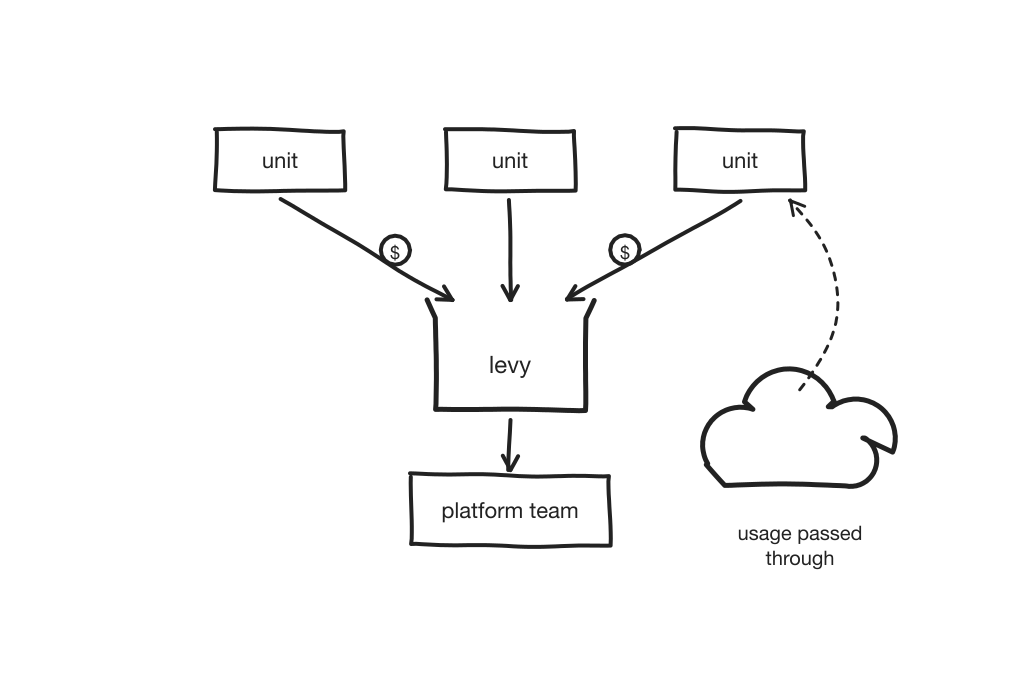
Pay for a shared platform from a pot that using it doesn’t increase: pass consumption through to the units that incur it, and fund the platform team by a levy every unit pays.
In This Context
Each simple way of funding a shared platform has a failure built in. When nobody pays (a central budget), the platform is a free service with a fixed capacity, demand is unlimited, and the platform team can never keep up. When teams pay by use (chargeback), every team has a reason to avoid shared services and build its own, and shared components lose their owner. And as long as the platform’s cost sits on one budget holder’s line, the more it’s used the more that line grows, while the benefit lands on everyone else’s.
You notice this either as duplicated tooling across units (users avoiding a charge), or as a platform backlog that never shrinks (users treating it as free).
Therefore
Use a hybrid that cancels out the worst of each model:
- Pass consumption costs (such as the cloud bill) through to the business units that incur them, allocated by tagging and agreed keys.
- Fund the platform team and the platform itself from a separate tax that every unit pays, whether or not it uses the platform, so using it costs nothing beyond a unit’s own consumption.
- Keep the funding model separate from any saving. The model only decides who carries the platform’s cost; check that each unit’s line still falls once its share of the tax is added.
Consequently
- Units have a reason to use the platform rather than duplicate it.
- Shared components have a funded owner.
- The tax and its key will be argued over every year.
- Units that pay start to behave like customers, wanting a roadmap, service levels, and a say.
- A unit that uses the platform lightly may only just break even, and is the one most likely to object.
Seen In
Chapter 17, “Hybrids” and the conclusion (no section anchors yet); Chapter 17, “Designing a Chargeback That Doesn’t Become Connector’s”; Chapter 17, table “Ways to fund a shared platform, and what each one tends to do”; Chapter 17, table “Jan and Neil’s first estimate: the tooling each business unit switches off, against its share of the platform tax (thousands of dollars a year)” (its figures are marked in Chapter 17 as illustrative, invented by an AI); Jan’s ending in ch18_plan.asciidoc; the comparison with Connector in part4_plan.asciidoc.