Patterns / 5. Changing the Flows
Pattern 5.6
Fund Products, Not Projects
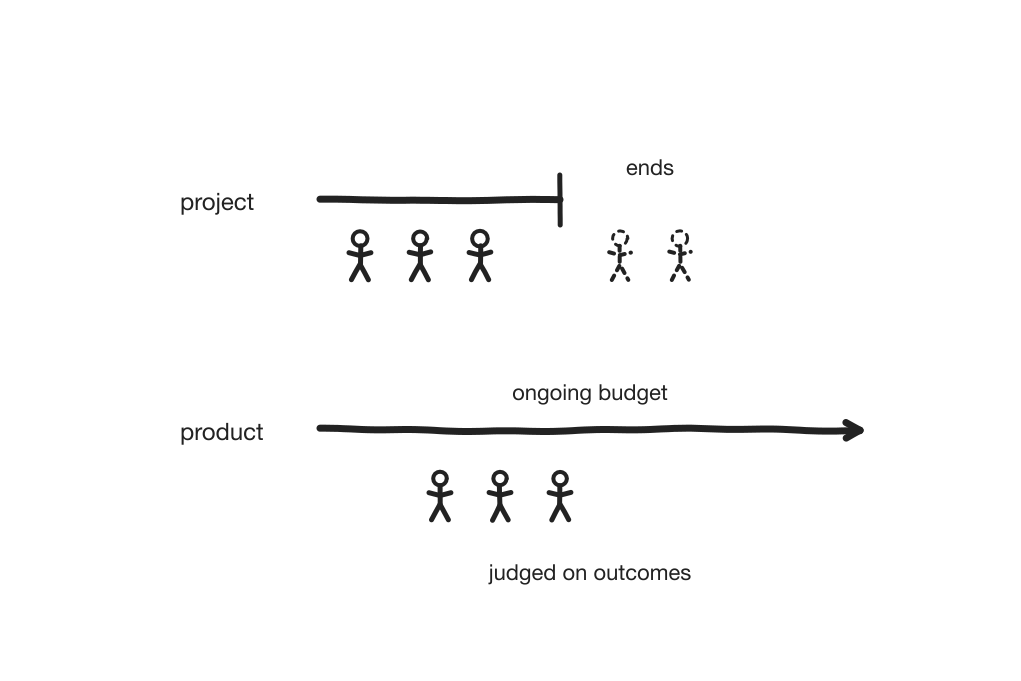
Fund long-lived teams with ongoing budgets judged on outcomes, rather than funding projects that end.
In This Context
Funding by project means a fixed scope, an end date, a business case approved up front, and often a capitalized cost. Funding by product means a long-lived team with an ongoing budget, judged on outcomes, and paid for mostly from operating budgets. Most organizations that “go product” change the names of their teams and keep funding projects. The teams drift back to the project shape, because that’s what the money rewards. A platform that is “done” in the accounts but still alive in engineering starves.
You notice this when “product teams” still write a business case for each piece of work, when funding is questioned once the work is “done,” or when shared platforms are missing from the project portfolio altogether because they have no project of their own.
Therefore
Fund the team, not the project, and deal with what that changes:
- Decide who chooses what the team works on between business cases, and trust them with the money.
- Move the funding on the same cycle as the planning (see Rolling Budgets).
- Plot projects and the long-lived teams they depend on together (a portfolio bubble chart), to show which teams are being kept alive by whichever project is funding them this year.
Consequently
- Funding doesn’t stop when the work is “done,” so the product doesn’t decay.
- Someone has to be trusted with money between business cases.
- What counts as capital and what counts as operating cost becomes an argument every year, because a long-lived team builds and maintains in the same week.
- A team funded year after year sits on an operating line, and operating cost growth is what a CFO measuring line-by-line growth will watch.
- Changing the planning cadence without changing the funding cycle leaves the project shape in place.
Seen In
Chapter 17, “Project Funding and Product Funding” (no section anchor yet), including the Portfolio Bubble Chart tool; Chapter 10, sidebar “War Story: Project to Product Platform”; Chapter 6, sidebar “War Story: Accounts Say ‘Done’ but Engineers Don’t”; Chapter 3, figure “WidgetSoft: organized around its software, or around its customers”; Chapter 15, sidebar “War Story: Budgeting Every Three Months”.