Patterns / 5. Changing the Flows
Pattern 5.7
Rolling Budgets
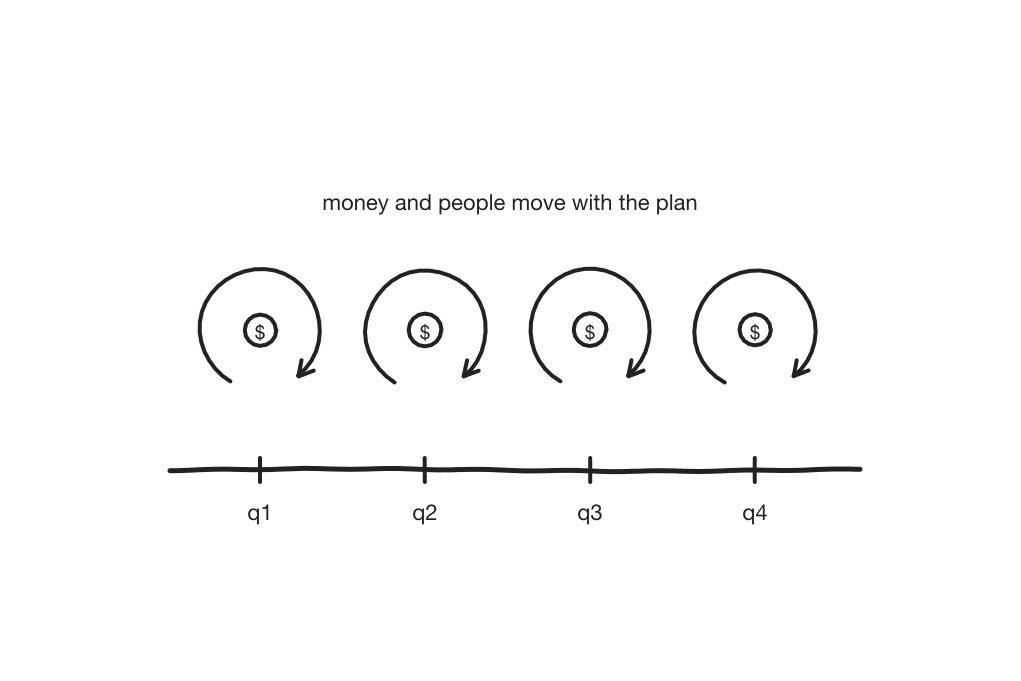
Move money and people on the same cycle as the plans, rather than fixing them once a year.
In This Context
In most organizations, budgets are argued over and set once a year, and then nobody wants to reopen them. An initiative that arrives just after the round has closed creates more problems for the budget holder than it solves. There are ways to find money outside the window (discretionary budgets, innovation funds, year-end underspend, reforecasts), but each comes with strings. Some organizations have moved their planning to a quarterly cadence while the money still arrives every January, which leaves the project shape in place.
You notice this when good ideas wait a year for the next round, or when teams plan every quarter but their budgets change only once a year.
Therefore
Reallocate money and people at each planning point, not just work.
- At each planning event, change budgets and move teams and staff to match the plan, as one large manufacturing business did at its quarterly SAFe PI Planning events.
- At the scale of a whole company, replace the annual budget with a rolling process, as Statoil (now Equinor) did with “Ambition to Action.”
- If you can’t change the cycle, work with the calendar you have (Pitch in the Budget Window).
Consequently
- An idea that misses one window waits three months for the next, not a year.
- It doesn’t fix everything else: the manufacturing business still had coordination problems, turf wars, and late deliveries.
- The evidence for company-wide versions is thin: most accounts of Statoil’s come from Bjarte Bogsnes, who led it.
Seen In
Chapter 15, “Timing: Exploiting the Budget Cycle” (Statoil, with the Bogsnes footnote); Chapter 15, sidebar “War Story: Budgeting Every Three Months”; Chapter 17, “Project Funding and Product Funding” (ING’s QBRs as the planning-only contrast); Chapter 1, “Budget Cycles”.