Patterns / 5. Changing the Flows
Pattern 5.8
Share the Saving
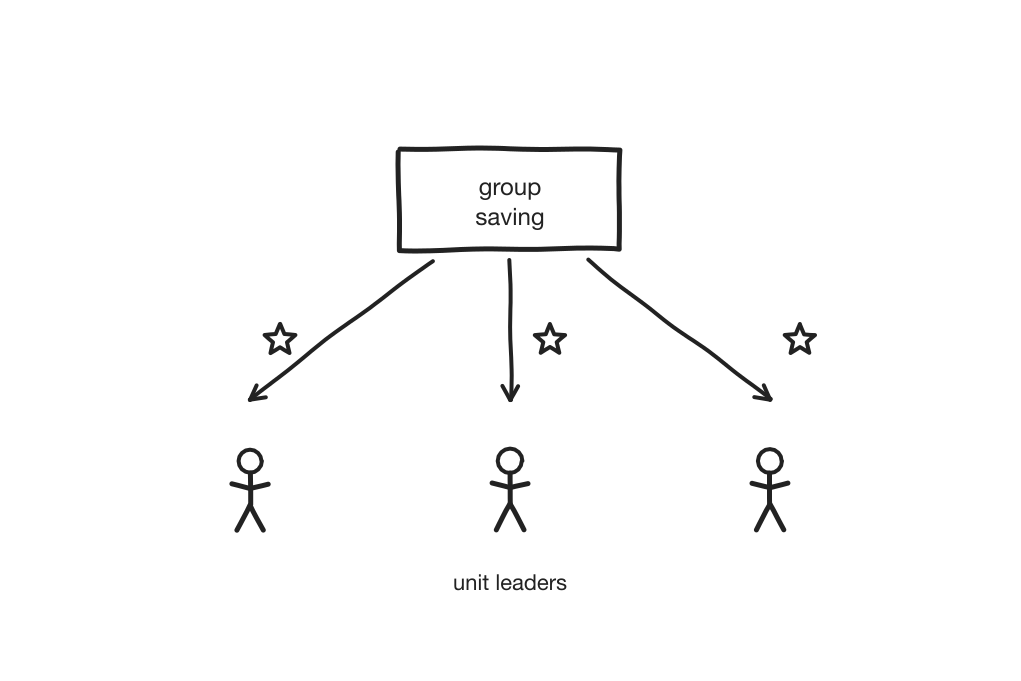
Tie part of each unit leader’s reward to group-level savings, so that shared work becomes something they want rather than something they tolerate.
In This Context
Organizations often state a goal, such as group efficiency, that nobody below the top is paid to deliver. At CapitalMesh, the group CIO carries the efficiency target, but the business unit CIOs are measured on delivering their own projects on time. A shared platform helps the group’s number and none of theirs, so they tolerate it rather than want it. A unit whose saving is small has no reason to accept its share of the platform’s cost.
You notice this when a group-level efficiency target sits with one person, while the unit heads whose cooperation it depends on are measured only on their own delivery.
Therefore
Put a share of group savings into the targets of the unit leaders whose cooperation is needed.
- Find out who sets those targets. Usually it’s the units’ own heads, and changing them takes the CFO or the board.
- Tell the people who can pull this lever that it’s there, but don’t make your plan depend on it.
Consequently
- The shared platform becomes something unit leaders want, and light users have a reason to accept their share.
- It’s the lever furthest out of reach of most engineers and managers.
- It’s easy to pull badly: a target changed in a hurry gets exactly what it measures, and some things nobody asked for (see The Imposed Target).
Seen In
Chapter 17, “Incentive Structures” (no section anchor yet); Chapter 15, figure “Jan’s platform metrics and Zack’s, with nothing joining them”; Chapter 15, “Work Toward What Gets Measured”; Chapter 17, table “Jan and Neil’s first estimate: the tooling each business unit switches off, against its share of the platform tax (thousands of dollars a year)”.