Anti-pattern 7.7
The Free Platform
A shared platform is free to use, has a capacity fixed once a year, and faces unlimited demand.
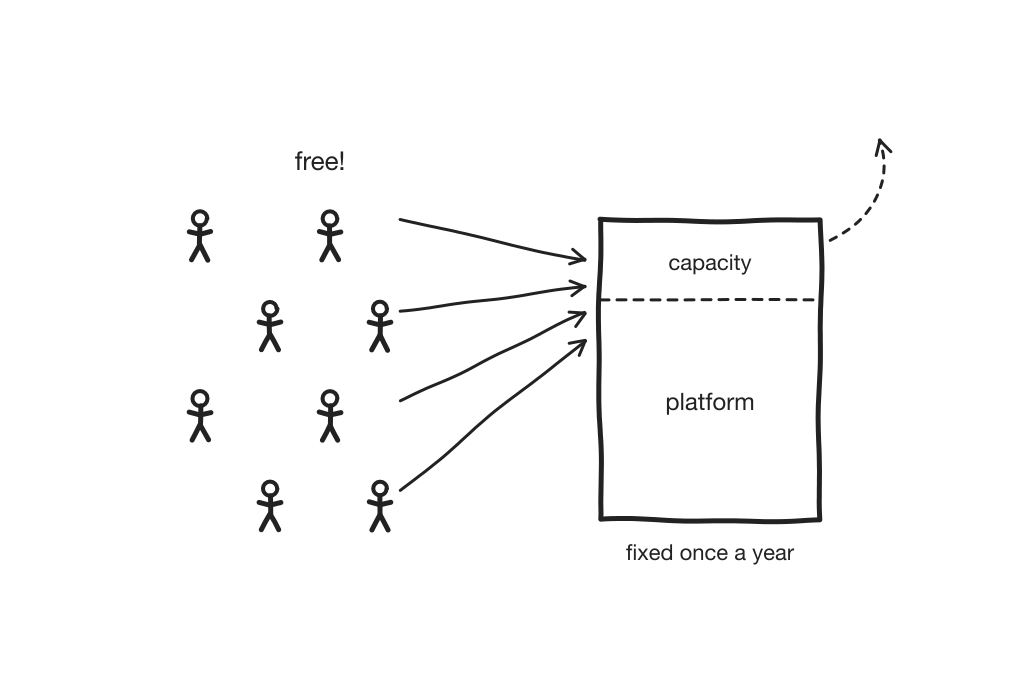
In This Context
A shared platform is paid for from a central budget held above its users. It’s simple, nobody argues about who owes what, and its users like it that way: asked to contribute, they say it ought to be funded by internal IT. As adoption grows, the platform’s costs grow on the one budget that sees none of the benefit.
Therefore
The platform stays centrally funded and free at the point of use. When the queue grows, the platform team argues that it is too busy and needs more people.
Consequently
- Adoption is easy, because the platform costs its users nothing.
- Demand is unlimited, and the queue is a predictable result of the funding: every extra request lengthens the wait for everything else.
- The cost of the wait lands on the users’ side of the business, where nobody counts it.
- The platform’s cost grows with its success, and it’s first in line for cuts at every budget round.
- “We’re too busy” doesn’t win a budget, because almost every team says it.
- A better approach: Showback Before Chargeback, Fund the Commons Separately.
Seen In
Chapter 16, “Jan’s Question: ‘Why Is the Platform Team Not Delivering Fast Enough?’”; Chapter 16, sidebar “War Story: Managing Impatient Stakeholders With Dependency Graphs”; Chapter 2, figure “Multiple teams have urgent work items to fulfill, but the platform team is only funded to deliver one of them”; Chapter 1, figure “How the platform’s success created Jan’s problems: adoption drives up demand and cost, but the budget that would have to absorb them is fixed”; Chapter 17, “Central Budget”.