Patterns / 5. Changing the Flows
Pattern 5.4
Choose the Key Carefully
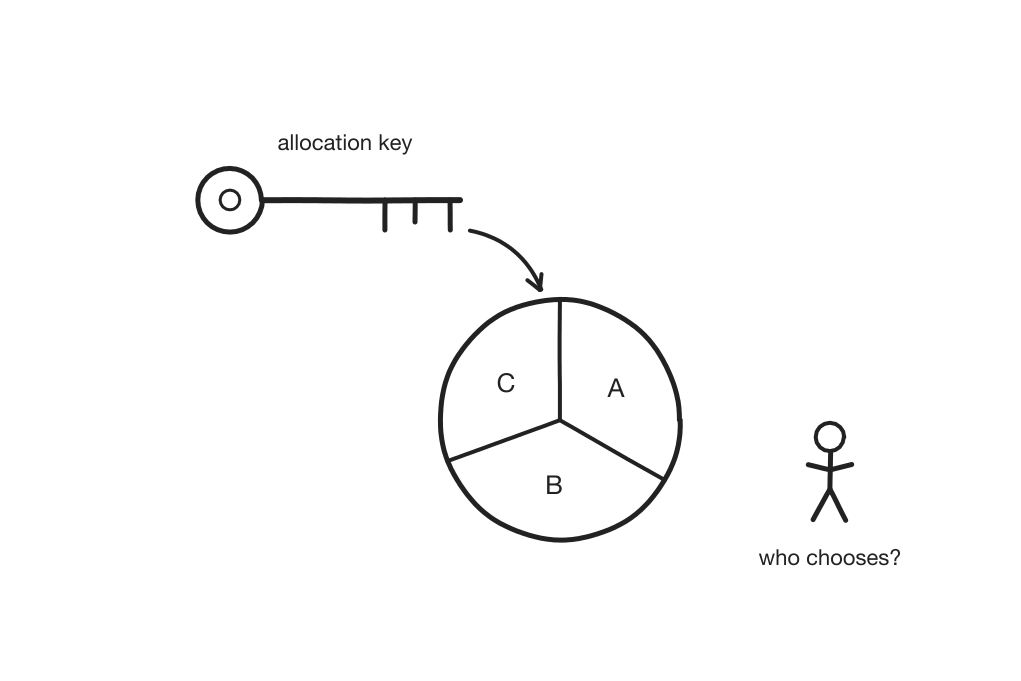
When a shared cost is split between units by a key, the key decides who wins. Choose it for the behavior it produces, and decide explicitly who gets to choose it.
In This Context
In a tax model, or any allocation of overhead, each unit pays an agreed share. The share is set by a key, and every key rewards someone. A hypothetical logistics company funds a central data platform by a tax split by headcount. Its warehousing unit barely uses the platform, pays the most, and lobbies every year to cut the tax; its pricing team is the heaviest user, pays the least, and has no reason to stop asking for more. Within two years, the warehousing unit has built its own reporting stack. Nobody is behaving badly: each unit is doing what the key rewards. Budgets are also markers of power, so a key that moves budget between units moves power too.
You notice this when the same unit lobbies to cut its share every year, or when light users build their own versions to show they don’t need the central one.
- Headcount is easy to measure, but has nothing to do with usage.
- Revenue charges those who can most afford it, until a high-revenue, low-use unit notices.
- Usage tracks benefit most closely, but turns the tax into chargeback by another name.
Therefore
Treat the key as the most political decision in the funding model, and choose it on purpose.
- Write down what each candidate key would reward and punish.
- Map who decides the key, as you would any other decision. At CapitalMesh, finance recommends it, the business unit CIOs give input, and the group CIO decides.
- Don’t let the team that is funded choose the key that funds it.
Consequently
- The politics of the platform become the politics of the key: argued openly, once a year, rather than fought out in shadow IT.
- A key chosen by someone neutral is more likely to be trusted than one chosen by its beneficiary.
- Whatever the key, some units subsidize others, and the argument over it comes back at every budget round.
Seen In
Chapter 17, “Tax” (the logistics company is presented as hypothetical) and “Cost Centers, Profit Centers, and Overhead” (no section anchors yet); Chapter 17, table “Decision rights for Jan’s platform, with the allocation metric added”; the turf war row of Chapter 16, table “Engineering complaints translated into financial terms”; Chapter 14, sidebar “Shadow IT Mapping”; Chapter 15, “Beyond the Bonus”.