Pattern 2.3
Map the Patrons
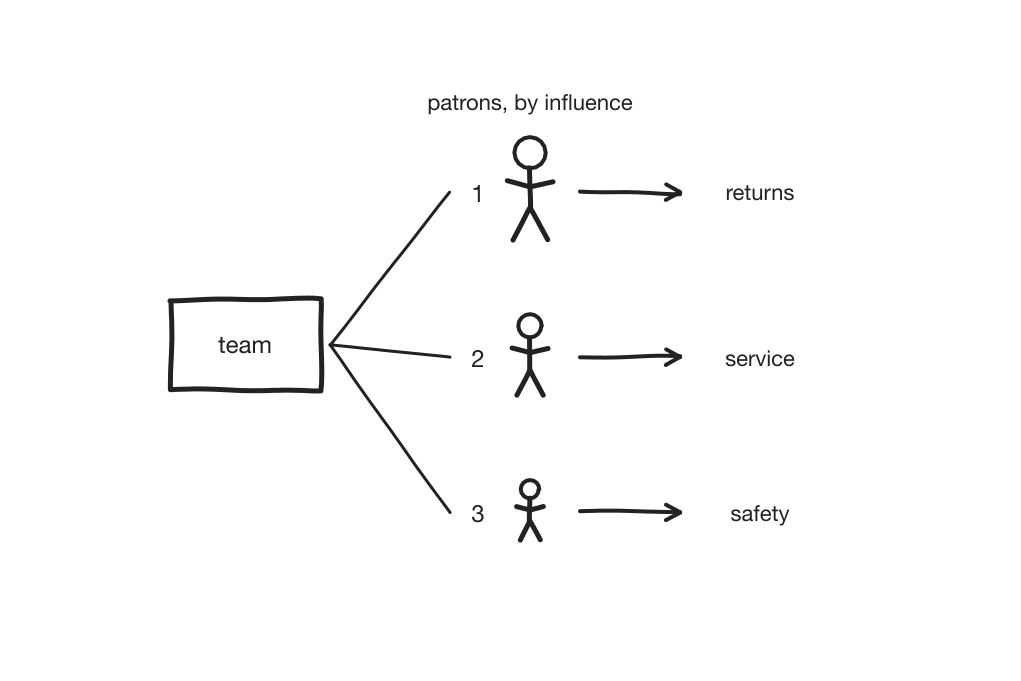
Have the group agree on who the organization (or team) really serves, rank those patrons by influence, and link each one to what they expect to get back.
In This Context
Ask people in an organization who it exists to serve, and you rarely get a single answer. Engineers may say the end users, sales may say the largest customers, and leadership may say the investors. Each answer is an implicit theory of who the patrons are, and teams working from different theories see each other’s decisions as irrational. Patrons are not the same as customers or stakeholders. A patron supplies something the organization needs, such as money or permission to operate, and could withhold it. An internal team’s patron may be the person who controls its budget rather than the people who use what it builds, as Jan’s was.
- Engineers often leave investors, budget holders, and procurement off the list, and leadership teams sometimes leave off users.
- The patron map changes with the boundary chosen.
- Gatekeepers can block work without funding it, and are easily mistaken for patrons.
Therefore
Run a short workshop: agree on the terms and the boundary, have each person list the patrons on their own before any discussion, then cluster the lists, rank the patrons by influence, and list the main outputs each one expects.
- Ask what input each patron supplies or could withhold, and move any that fail that test into a separate gatekeepers column.
- Base the ranking on a recent decision: whose request changed the roadmap, and whose was set aside?
- Record the disagreements the group can’t resolve.
Consequently
- Disagreements about who the patrons are become visible, and they are usually the most useful finding.
- The map shows whose support a team needs and what kind of argument those people will respond to.
- It can show how much effort goes into satisfying patrons who never pay for the product, such as regulators and investors.
- The map resolves nothing by itself. It only sets up the next question, which is whether the organization’s structure matches its patrons.
Seen In
Chapter 11, Chapter 11, figure “Simplified diagram of patrons and outputs for an ad-funded, VC-backed service”. Also: Chapter 11, “Running the Mapping Workshop”, Chapter 11, figure “Patrons and outputs of CapitalMesh’s Internal IT” (Jan’s Internal IT).