Pattern 2.2
Agree the Goal and the Boundary
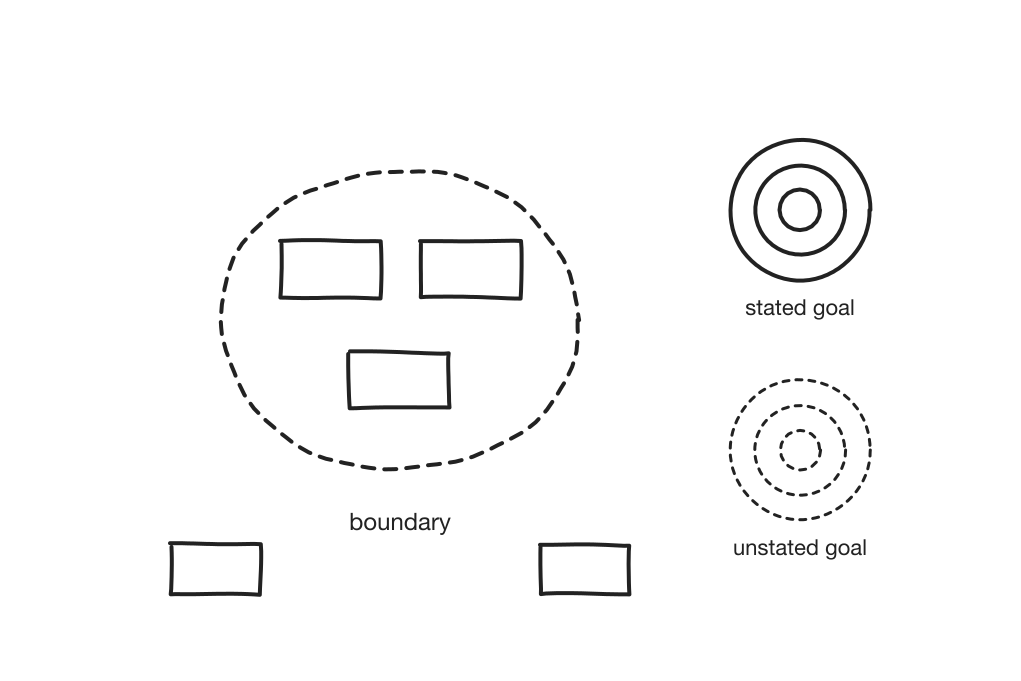
Before mapping anything, agree with the sponsors on what the analysis is for and which part of the organization it covers, and separate the goals they state from the ones they don’t.
In This Context
Sponsors commission an analysis for many reasons: to find out why a change program is stalling, why engineering output doesn’t match business expectations, or why technical decisions keep turning into commercial disputes. The stated goal is rarely the whole picture. A sponsor might champion a change program to secure their own position or to protect a favorite project. Where there are several sponsors, they may each have different levels of commitment to the goal, and the organization notices. The scope can also be unclear, and a diagnosis that wanders into an area nobody agreed to examine, such as an executive’s sales incentive scheme, can turn into a political confrontation.
- Each sponsor’s business unit may answer to different patrons, with different incentives.
- Middle managers who notice disagreement at the top may wait for the push for change to die away.
- An unclear scope is often a sign that the organization itself is unstable.
Therefore
Ask each sponsor what they want the analysis to achieve, and write it down. Agree on whether the scope is a team, a department, a product line, a business unit, or the whole business, and agree on what is out of scope.
- Distinguish between identifying a constraint outside the scope and claiming the authority to redesign the part of the organization that creates it.
- Where sponsors disagree, record the disagreement as an early finding about the patron model behind the change.
Consequently
- Recommendations can be framed for the level of the organization that can act on them.
- The analysis is less likely to blunder into political territory nobody signposted.
- If the sponsors don’t share one patron model, this shows up early. It doesn’t go away, and it may predict that the change itself will stall.
- Agreed boundaries don’t protect the sponsor from tough feedback, and shouldn’t.
Seen In
Chapter 10, figure “The three-CEO transformation: a central strategy against local money flows”, Chapter 10 “Delineate the Boundaries”. Also: the war stories “Three CEO Sponsors’ Goals” (Chapter 10, sidebar “War Story: Three CEO Sponsors’ Goals”) and “Failure to Agree on Boundaries” in Chapter 10.