Patterns / 3. Working Within the System
Pattern 3.4
Coalition With Money
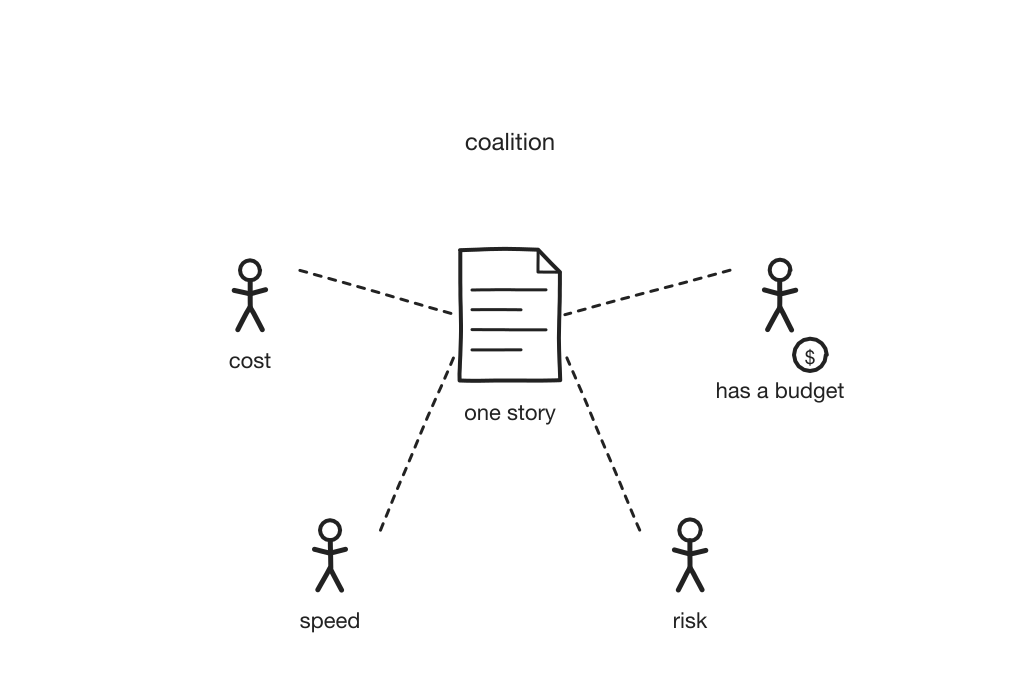
Bring together several people who want your change for different reasons, held together by one story that each of them can retell, and include at least one early adopter who has money of their own.
In This Context
One ally asking for something is a favor. Several parts of the organization asking for the same thing is a pattern, and patterns are what get a senior decision-maker’s attention. The people who benefit from a shared change usually sit under different budgets and are measured on different things, so no single incentive will hold them together. Meanwhile, the person who pays for the change is often not the person who benefits from it.
You can see the need for this pattern when you are the only person arguing for your change, and the people who would benefit from it aren’t in the room when it is decided.
- Each potential ally has a different reason to want the change.
- Allies with money of their own are worth more than several without.
- Informal influencers have no formal target to align with, but can still carry an argument.
Therefore
Build the coalition before the budget window opens, around a story rather than a shared incentive.
- Use the decision rights map to decide whom the coalition is for (in Jan’s case, the group CIO).
- Give each member their own reason to join, and one shared story they can all retell.
- Look for allies on the informal influence lines from the org mapping, and among the people who were quiet in workshops but opinionated in one-on-ones.
- Find an early adopter with money and a pressing need.
- Use small wins to recruit, because people join initiatives that look as if they will succeed.
Consequently
- The decision-maker hears demand from several directions at once.
- A growing coalition shows that the push for change isn’t going to dissipate, which is the hope of managers waiting it out.
- The story has to work for everyone in the coalition. If they can’t retell it, they can’t advocate for it.
- It takes time, and it has to exist before the numbers for the budget round are prepared.
Seen In
Chapter 15, figure “Jan’s possible coalition: different reasons, one story”, Chapter 15, figure “Who decides, what they’re measured on, and who might back Jan”; Chapter 15, “Coalition Building”; the middle managers in Chapter 10, sidebar “War Story: Three CEO Sponsors’ Goals”; the platform team and the CISO in Chapter 15, sidebar “War Story: The Security Finding as a Trojan Horse”.