Patterns / 3. Working Within the System
Pattern 3.1
Find the Real Decider
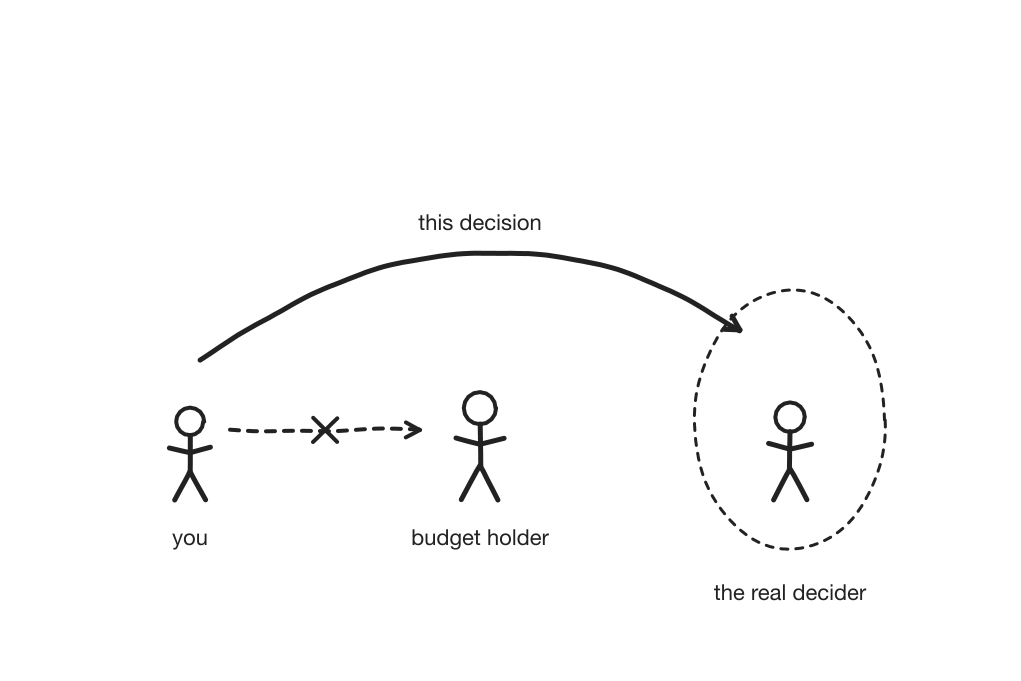
For the specific decision your change depends on, find out who really decides, rather than pitching to the person who controls your budget.
In This Context
The person with formal authority over your area is often not the person with the money, and the person who is powerful in general may have no say over the one decision you need. Shared, cross-unit work is the classic case. Every unit can veto it, but none can decide it, so the decision escalates until it reaches someone senior enough to make it, who may not have the time or the wish to disappoint anyone. Pitch to the wrong person and you get a no from someone who could say no and had no reason to say yes.
You can see this pattern when decisions keep escalating, stalling, or being reopened, especially in matrix organizations where people have more than one boss.
- Reporting lines and funding lines can point to different people.
- Power in general is not the same as power over one decision.
- A decision with no owner, or several, stalls.
Therefore
Map decision rights one decision at a time, and go to the source of the money.
- List the decisions your change depends on.
- For each one, record who recommends, agrees, performs, gives input, and decides (Bain’s RAPID roles), and any spending thresholds.
- Treat any row with no D, or more than one, as a finding.
- Ask of each person: can they say yes, can they say no, and can they make someone else say yes?
Consequently
- You pitch to the person who can actually decide, and you know whose no is fatal.
- It often shows that you need more than one decision to go your way: in Jan’s case, funding from the group CIO, and adoption from each business unit CIO.
- Presented as a proposal for who ought to decide, the map becomes a fight about authority, and people whose authority looks smaller on paper will treat it as an attack.
Seen In
Chapter 15, table “Decision rights for Jan’s platform at CapitalMesh”; Chapter 15, “Who Is Really in Charge?”; the data team funded by Marketing in Chapter 12, sidebar “War Story: The Team Marketing Paid For”.