Pattern 2.9
One-on-Ones Before Synthesis
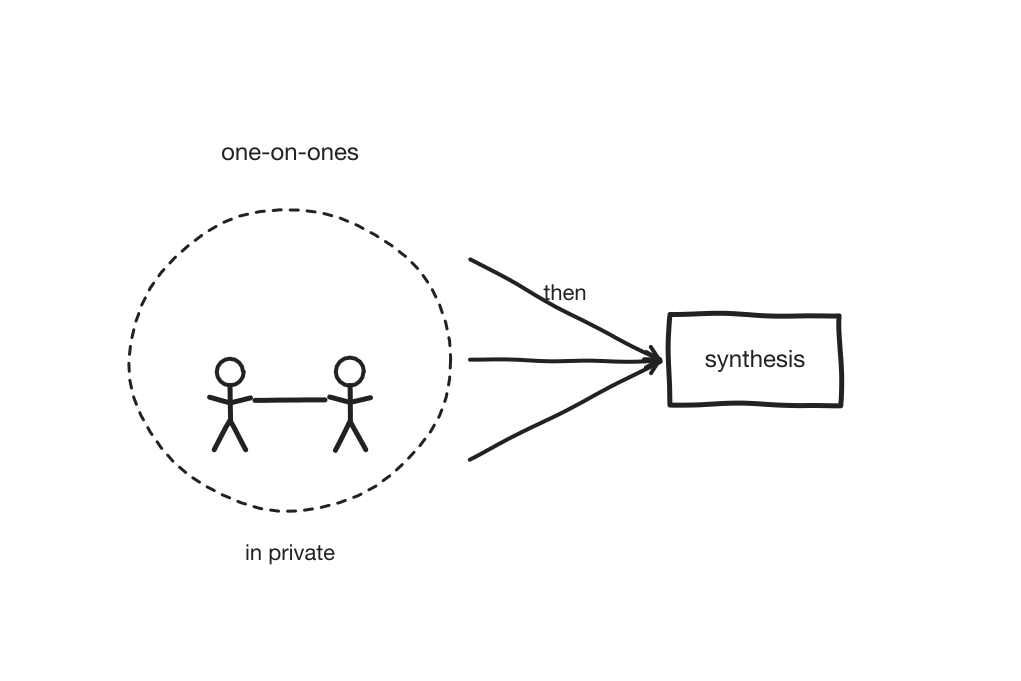
Before drawing conclusions, meet privately with the people the workshops couldn’t hear from, or couldn’t hear freely.
In This Context
Workshops are shaped by who is in the room. Authority figures, formal and informal, can skew the discussion and stop people from speaking freely, as can their known preferences. Some people are quiet in the group and opinionated in private. Others are missing altogether, such as the owners of gates that came up in the value stream, or the owners of orphaned components. The gap between what someone says in a group and what they say alone can itself be revealing.
- The most senior people shape what is said in any session they attend.
- Many findings trace back to people who weren’t in the workshops.
Therefore
After the workshops, hold one-on-ones with the people noted as follow-ups:
- the owners of gates that weren’t in the value stream workshop;
- the owners of orphaned components and of constraints nobody could explain;
- anyone who went quiet when their part of the organization, the flow of work, or the system came up;
- the most senior people, separately.
Only then pull the four maps together and trace the sponsor’s main problems back along the chain.
Consequently
- The diagnosis includes what people wouldn’t say in the room.
- Usually there are few surprises, but the ones there are can be important.
- The gap between public and private views becomes a finding in itself.
Seen In
Chapter 14, “One-on-Ones”. Also: the war story “When the CEO Left the Room” (Chapter 12, sidebar “War Story: When the CEO Left the Room”), Chapter 14, “Synthesis and Diagnosis”, and the agenda in Chapter 10, table “Agenda structure”.