Patterns / 3. Working Within the System
Pattern 3.10
Let a Customer Pay
When the central budget won’t fund your work, find an internal customer with a pressing need who is willing to pay for it from their own budget.
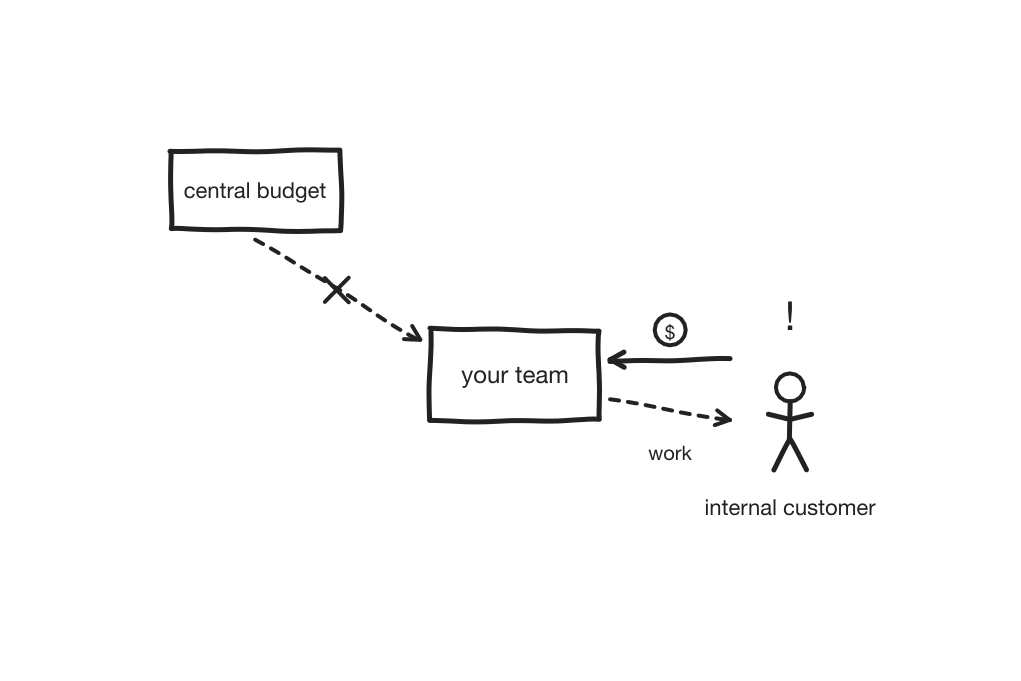
In This Context
A shared service funded from one central budget has fixed capacity and, because its users pay nothing, effectively unlimited demand. The people waiting for it often have money of their own and deadlines they have committed to, and the wait is a cost on their side of the business. Some of them would pay to make it go away. Others will insist that the service ought to be funded centrally, because that suits them.
You can see the opportunity for this pattern when a customer keeps chasing you for one feature, has money, and has dates of their own to meet.
- The customer bears the cost of the wait, not the central budget holder.
- Customers who pay expect a say.
- Some customers would rather argue for central funding than pay.
Therefore
Ask the customer to fund the work, or to contribute something toward it.
- Pick a customer with a pressing need and money (such as a business unit CIO with blocked projects).
- Agree what they are paying for, and what they get in return.
- If they won’t pay, ask them to contribute people, or to make the case with you to the central budget holders. Asking forces them to consider how badly they want it.
Consequently
- The work gets funded outside the central budget, and the customer becomes an early ally with money.
- Money from a customer brings a customer’s expectations, which is where chargeback models begin.
- Many customers will decline, preferring to argue that the service should be centrally funded.
Seen In
Chapter 15, “Other Ways to Find Room” (“Let a customer pay”); Ravi in Chapter 13, “A Worked Example: CapitalMesh”; the business units that wouldn’t contribute in Chapter 16, sidebar “War Story: Managing Impatient Stakeholders With Dependency Graphs”.