Patterns / 1. Context: Money Smells
Pattern 1.9
Wooden Dollars
A central service is expected to “sell” to internal customers who can ignore it, and neither side can really walk away.
In This Context
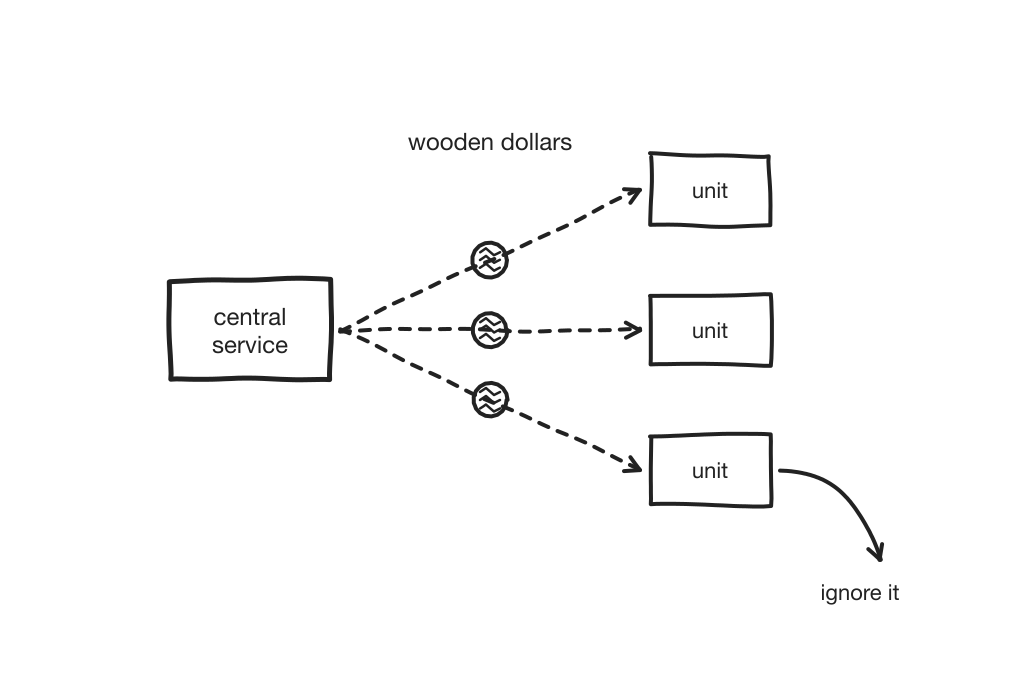
Larger organizations use internal proxies for money (cross-charging, recharging, chargeback, or “wooden dollars”) to make internal relationships look like a market. In practice the resemblance is often superficial: the consuming team usually can’t take its money elsewhere, and the providing team can’t refuse to serve. Where no money moves at all, a central services function may still be expected to win over semi-autonomous units that are free to ignore it, while those units’ own money flows reward local optimization. On the map, internal customer lines have no money moving along them, from units that can walk away.
- The central team’s success depends on others choosing to consume it.
- The units are rewarded for their own results, not for adoption.
- Middle managers may wait for the push for change to dissipate.
Therefore
Ask two questions of every internal customer: does money actually move between budgets, and can either party walk away? If neither, the real patron is whoever sets both budgets; take the case there. Where a unit has a pressing need and its own money, let it pay for what it wants (Let a Customer Pay), and fund the shared service so that using it is not a choice the units have to be talked into (Fund the Commons Separately).
Consequently
- The decisive patron, the one who mandated the arrangement, becomes visible.
- But left alone, adoption stays low, and the central team gets the blame.
- But a customer that pays also expects a say.
Seen In
Chapter 11, figure “Internal ‘wooden dollar’ customers: how the relationship looks, and how it works in practice”, Chapter 10, sidebar “War Story: Three CEO Sponsors’ Goals”.