Patterns / 1. Context: Money Smells
Pattern 1.3
Budget Silos
Each business unit buys or builds the same function from its own budget, because nobody is rewarded for using someone else’s.
In This Context
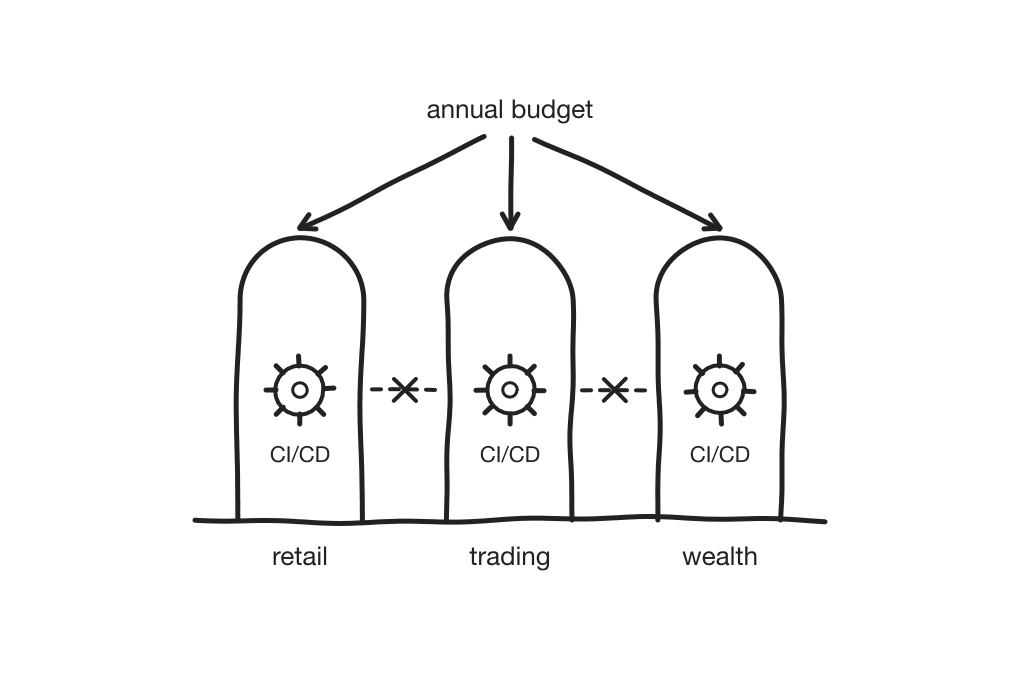
In large organizations, funding goes to business units on a yearly cycle, and each unit leader is judged on their own unit’s performance and budget. Collaboration across units is discouraged by the structure itself. Unit leaders are often rewarded for growing the size and scope of their unit, measured in headcount, so building their own platform is more attractive than using another unit’s. The result shows up on the map as the same function (CI/CD, secrets management, Kubernetes) appearing in several units, each with its own budget and its own tool choices, some of them conflicting.
- Each unit optimizes for its own local budget.
- A saving made by sharing appears on no unit’s P&L.
- Empire building is often rewarded.
Therefore
Name the duplication and price it. The case for consolidation is strongest when it is stated as cost lines that can be switched off (The Deletable Cost Line).
Consequently
- Duplicated licenses and contracts become visible savings someone can claim.
- Left alone, the units keep duplicating tooling, and their architectures keep diverging.
- Consolidating takes something away from unit leaders who are measured on scope, so expect resistance.
Seen In
Chapter 1, figure “CapitalMesh’s business units’ tool choices, some duplicated and some conflicting”, Chapter 9, “The Financial Gravity of Teams”.