Patterns / 4. Reframing the Conversation
Pattern 4.3
Translate the Question
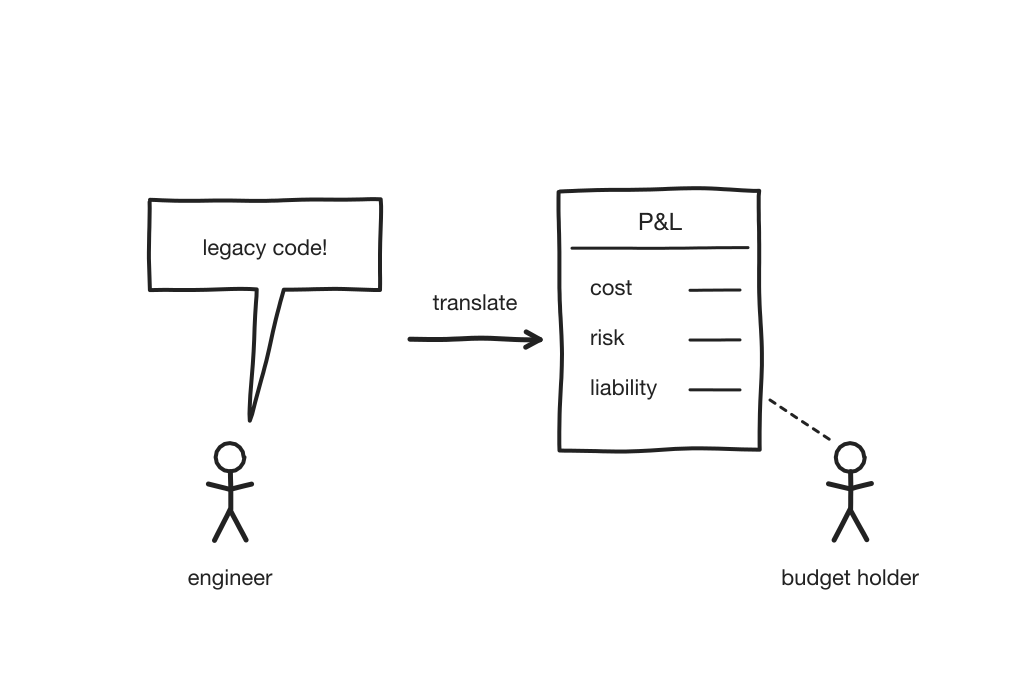
Restate each engineering complaint as a cost, a risk, or a liability that lands on a specific budget holder’s P&L.
In This Context
Engineers describe their problems in engineering terms: “we keep building the same thing,” “the platform team is a bottleneck,” “we’re locked in.” Each of these has a money flows explanation, and that explanation can be turned around into a translation. Duplicated effort becomes several budgets paying for the same capability. A slow platform team becomes a free service with fixed capacity, whose delay is a cost borne by the people waiting. This is the same exercise as aligning your proposal to one person’s measures, viewed from the problem’s side rather than the person’s, and you usually need both.
You can see this pattern is needed when every complaint is phrased as an engineering problem, and nobody can say whose P&L it lands on.
- Budget holders respond to costs they already have a mental model for.
- Each translation names a different budget holder.
Therefore
For each problem, write the engineer’s version, the finance version, and whose P&L it lands on.
- Start from the common complaints (duplication, turf wars, slow platforms, technical debt, cloud costs, build versus buy, procurement delays, shadow IT, lock-in, slow change, collapsing collaboration, unowned shared code).
- For each saving you are claiming, say whose P&L it lands on. If the answer is “nobody’s,” that is your real problem.
- Rewrite the first paragraph of your proposal without any technical terms.
Consequently
- The problem becomes concrete and actionable to the people with budgets.
- It shows whom to talk to for each problem.
- The translation doesn’t change the technical problem, and it may show that the cost lands on nobody who can act.
Seen In
Chapter 16, table “Engineering complaints translated into financial terms”; Chapter 2, “Money Flows and Software Challenges”; Chapter 16, “Jan’s Question: ‘Why Is the Platform Team Not Delivering Fast Enough?’”.