Patterns / 4. Reframing the Conversation
Pattern 4.4
Book the Unbooked Liability
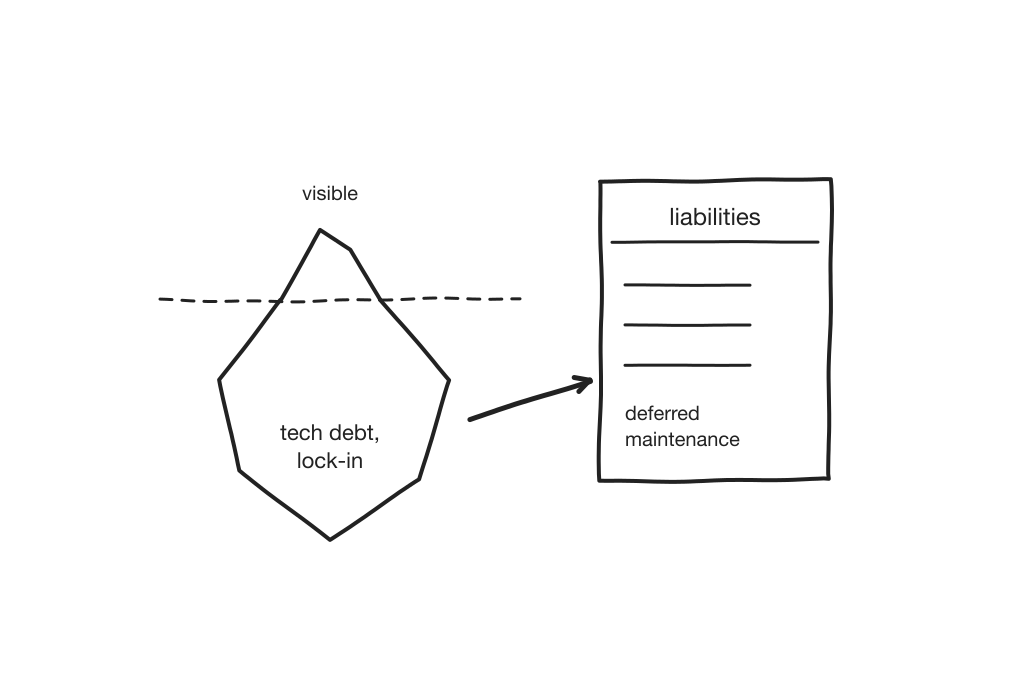
Present technical debt and vendor lock-in as liabilities with a cost, in terms finance already uses, such as deferred maintenance.
In This Context
Technical debt is a financial metaphor that engineers use far more than finance people do. To finance, debt is on the balance sheet, with a lender, an interest rate, and a repayment date. Technical debt has none of those, so it appears nowhere and is invisible to the people who hold budgets. Vendor lock-in is similar: the cost of leaving a supplier grows every year, but never appears in any one year’s budget, because nobody is leaving this year. Both become visible only when something fails, someone tries to leave, or the supplier raises its prices.
You can see this pattern is needed when engineers complain that the code is getting worse or that the organization is locked in, and nobody with a budget reacts.
- The cost lands on whoever owns the system when it fails, often not the person deciding today.
- Costs spread across years are invisible in the year the decision is made.
Therefore
Translate the problem into a liability finance recognizes, and make its cost visible in the year of the decision.
- Describe technical debt as deferred maintenance: a roof not repaired this year costs more next year.
- Describe lock-in as an exit cost that grows each year.
- As with total cost of ownership, show the cost spread over the years in the year the decision is being made.
Consequently
- The problem attaches to something people with money already have a mental model for.
- The translation doesn’t make the technical problem any more or less real.
- The person deciding today may still not bear the cost, so the translation alone may not move them.
Seen In
Chapter 16, “Debts and Liabilities Nobody Has Booked”; Chapter 2, “‘Why Is Technical Debt Allowed to Accumulate for Years?’”; rows of Chapter 16, table “Engineering complaints translated into financial terms”.