Patterns / 5. Changing the Flows
Pattern 5.10
Move the Money, Then the Org
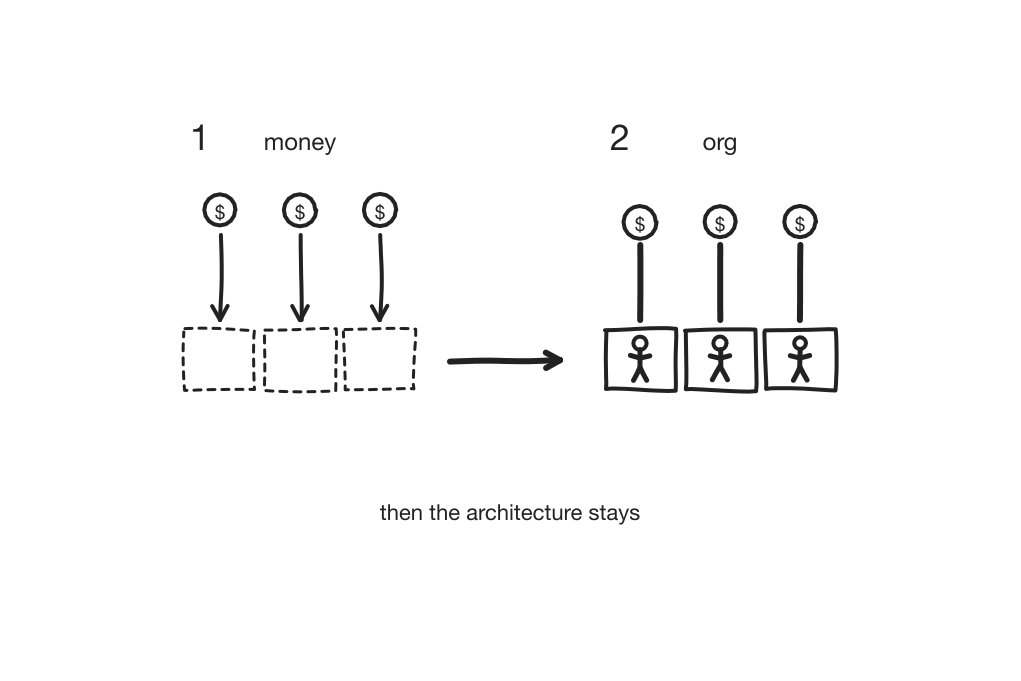
Before reorganizing teams to get the architecture you want, change how the new teams will be funded and what they will be measured on. Otherwise the old architecture comes back.
In This Context
The Reverse Conway Maneuver says: decide on the architecture you want, and shape your teams to produce it. Moving teams around is the lever most leaders already control, so it’s the one they reach for first. But if the money flows underneath stay the same, the forces that shaped the old system are still at work, and the old architecture reasserts itself. Connector shows the same force in reverse: its teams were reorganized by its funding model, and the architecture followed the money, not the org chart.
You notice this when a new org chart sits on top of the old budget lines, or when the first response to an architectural problem is “let’s reorganize.”
Therefore
Design the teams, the systems, and the funding underneath them together: the Reverse Conway Maneuver, one link further left along the chain.
- Before a reorganization, ask what each new team will be paid for by, and what it will be measured on.
- Choose the separations you keep on purpose. Some silos are useful, where teams need to specialize deeply or work at different speeds.
Consequently
- The new structure has a chance of sticking, because the money now pulls the same way.
- It’s harder and slower than a reorganization alone, because funding is further left on the chain and usually outside the reach of the people proposing the reorganization.
- Some separation between teams remains, by choice rather than by accident.
Seen In
Chapter 17, “Reverse Conway, One Link Further Left” (tool sidebar; no section anchor yet); Chapter 9, “Extending Conway’s Law”; the “Structure changed, money didn’t” row of Chapter 12, table “Common mismatches between the layers”; Chapter 15, figure “Reading the reactions to the workshop report”.