Patterns / 5. Changing the Flows
Pattern 5.11
Change the Patrons
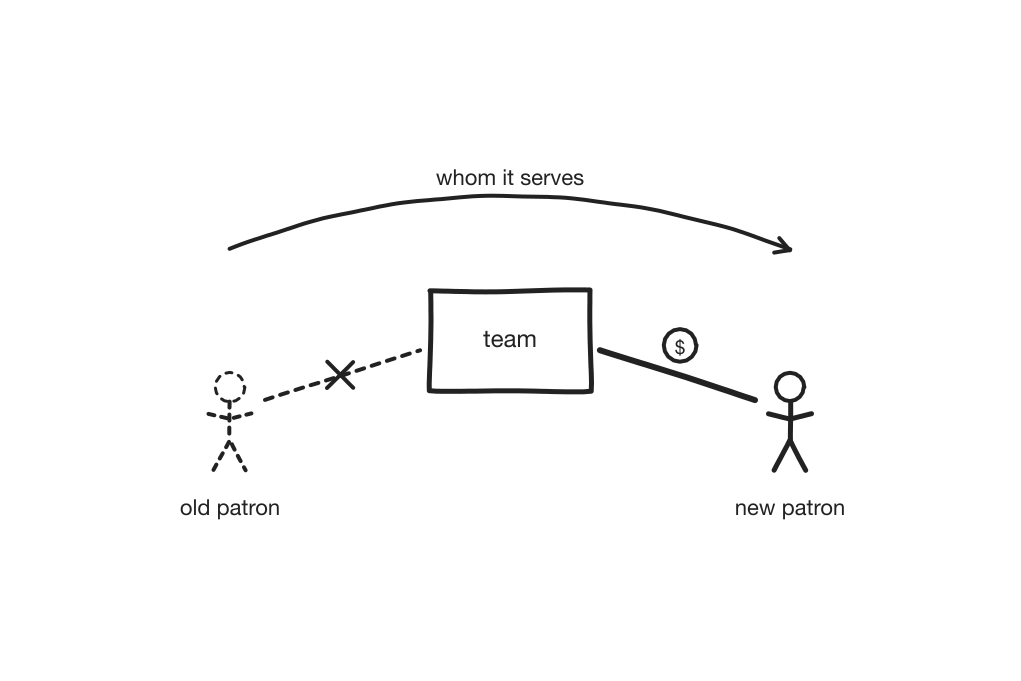
When the patrons themselves are what hold a system in place, the lasting change is to change whom the organization (or the team) serves, or who funds it.
In This Context
Patrons are the leftmost link of the chain from patrons to systems, and the further left a change is made, the harder it is and the longer it lasts. Part II showed patrons changing by accident: each new patron reshaped Collaboron, from its first customers through B&L, Momentum Ventures, and the public markets. At the scale of a whole business, changing patrons on purpose is rare, and usually takes something big. A change of ownership or a crisis is often what makes it possible, because it’s one of the few moments when management is willing to take the risk.
You notice this when every other lever has been tried, and the same customers or investors keep pulling the product back into shape.
- The patrons who constrain a product are often the ones who pay for it.
- Changing them puts that revenue at risk, and few people are willing to take that risk.
Therefore
At the scale of the business, watch for the moments that make a change of patron possible, such as a change of ownership or a crisis. At the scale of a team, make smaller versions of the same move:
- Choose which internal customers to serve first.
- Find a new sponsor.
- Move the team under a different budget.
Consequently
- The change lasts, because it acts on the link that everything else in the chain follows.
- New patrons bring new expectations. When a platform’s patrons change from one budget holder to the business units that fund it, that’s a much bigger change than it looks.
- Sometimes the patrons can’t be changed: when the customers who constrain the product are the money flow, there is no lever left to pull. That is a sign of a system that can’t be changed from the inside (see Recognize the Unwinnable System).
Seen In
Chapter 17, “Changing the Patrons” (no section anchor yet), including the war story “The Straitjacket”; Chapter 8, “How Changing Patrons Shaped Engineering”; Chapter 3, “WidgetSoft: A B2B Case Study”; Chapter 12, sidebar “War Story: The Team Marketing Paid For”; Chapter 9, figure “Patronage ultimately constrains system architecture”.