Patterns / 4. Reframing the Conversation
Pattern 4.8
Bridge the Metrics
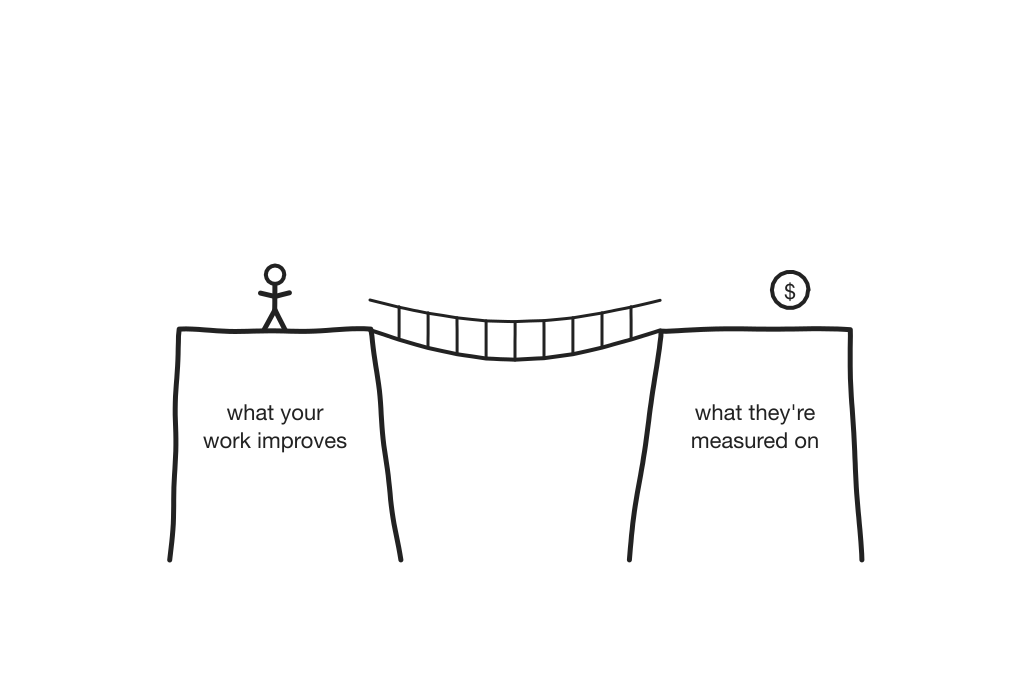
Draw the lines from what your work improves to what the budget holders are measured on, and build your case along those lines.
In This Context
Engineering teams measure their work on engineering terms: deployments per day, time to provision infrastructure, test coverage. Budget holders are measured on things such as budget per employee, license costs, and internal allocations. When nothing joins the two lists, your work is all cost and no benefit on the measures that decide its funding, however good it is on your own.
You can see this pattern is needed when you can put your metrics and your budget holder’s side by side in two columns, and draw no lines between them.
- Neither side is wrong; each is measured on different things.
- The lines have to be drawn in financial terms that the budget holder recognizes.
Therefore
Put the two sets of measures side by side, and make each line explicit in your case.
- Say which budget pays for the build, and keep that cost small.
- Say whose cost lines fall, and how this moves the senior decision-maker’s target, in the terms they already use.
- Show that it costs your own budget holder nothing on their measures, so they can agree without their numbers looking worse.
- Say how the result will be measured, against what baseline, and when.
Consequently
- Your budget holder can carry the case upward, and gets to be the person who brings a saving.
- The case is in terms that finance and the senior decision-maker recognize.
- Bridging the metrics changes the language, not the money flows: the work can remain nobody’s cost and everybody’s benefit.
Seen In
Chapter 16, figure “Jan’s metrics and the budget holders’, now joined through the financial terms of her case”; Chapter 15, figure “Jan’s platform metrics and Zack’s, with nothing joining them”; Chapter 16, “Conclusion: A Case Zack Can Carry”.